Shopify SEO that targets orders, not just rankings — collections that capture demand, product pages that convert, and a technical foundation that lets Google crawl the store properly.
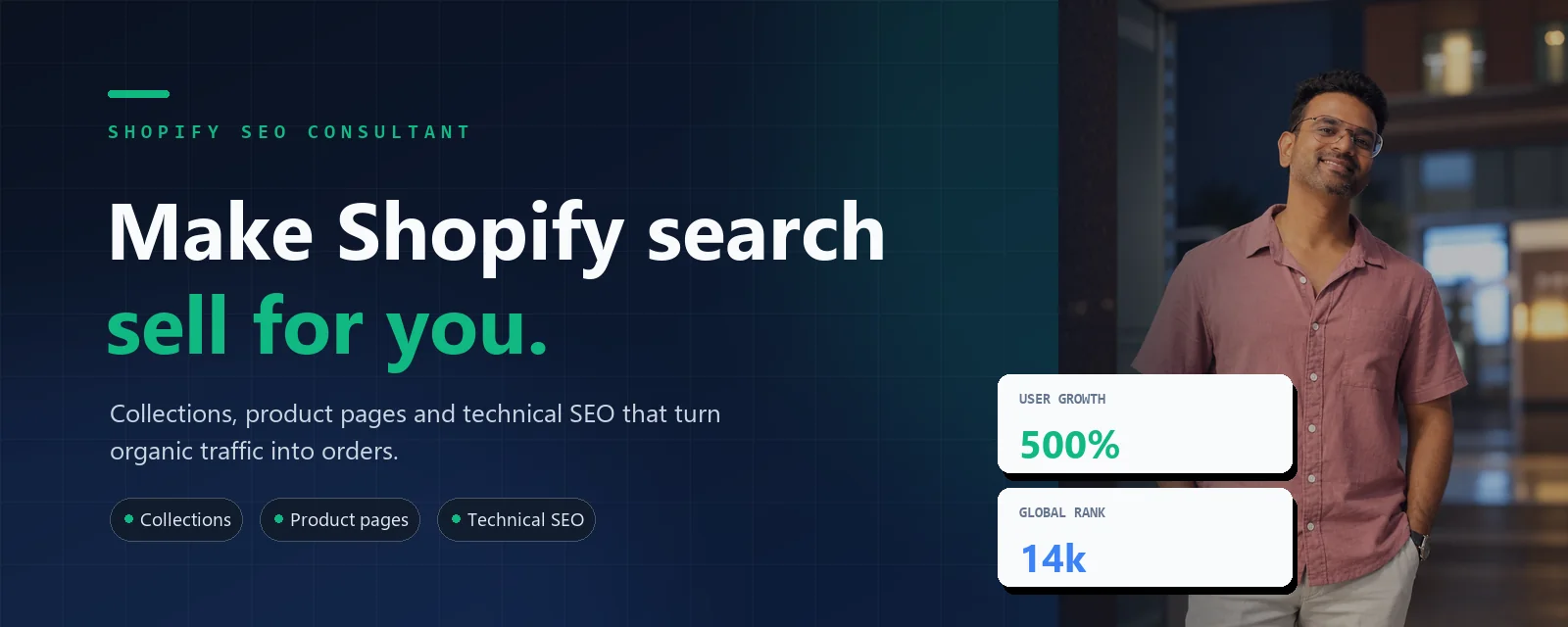
14k
Global rank, from 100k
500%
User growth in Shopify SaaS
12+
Years of SEO practice
I owned the SEO program for a Shopify-based SaaS — themes, apps, collections and the Shopify buying journey are familiar territory.
Overlap with US Eastern and Pacific hours — calls and same-day replies, not overnight waits.
A documented audit and roadmap, not a black-box retainer. Your team can execute any part of it.
Contract and pay in USD through Upwork (100% Job Success), or direct with an NDA.
You have products that sell, but organic traffic is flat and the collection pages are not pulling their weight.
Hundreds or thousands of SKUs, faceted navigation and duplicate URLs that quietly waste crawl budget.
You sell to merchants and need comparison, integration and use-case pages that rank in a crowded ecosystem.
A generic SEO checklist misses the parts of Shopify that decide whether collections and products can rank. Read the 17-point Shopify SEO checklist for the full order of operations.
Collection pages often become the money pages. They need clean URLs, unique copy, sensible filters and internal links from the blog.
Thin manufacturer copy and missing attributes cap both rankings and conversion. The fix is content plus structured data, not keyword stuffing.
Variants, filters, pagination, search pages and app-generated URLs can create thousands of indexable duplicates. They need to be controlled.
Every app adds scripts. I identify what is blocking Core Web Vitals and what can be removed or deferred without breaking the store.
Buying guides and comparisons should link to the collections and products they support — not live in a content silo.
GA4 and Search Console checked against non-brand queries, collection impressions and revenue — not a rankings screenshot.
| Generic SEO | Shopify SEO |
|---|---|
| Optimise the blog | Optimise collections and products first |
| One page per keyword | Manage variants, filters and pagination |
| Content is the main lever | Theme, apps and indexation matter too |
| Report traffic | Report non-brand revenue pages |
STEP 01
Crawl the store, check indexation, duplicates, collection coverage and theme/app performance.
STEP 02
Resolve the technical blockers and build a clean collection-to-product internal link structure.
STEP 03
Rewrite priority collections and products, add schema and ship the first supporting content.
STEP 04
Track non-brand impressions, collection rankings and revenue, then reprioritise the next 90 days.
As Digital Marketing Manager for Identixweb, a Shopify app-development SaaS, I owned the SEO program end-to-end: technical frameworks, a multidisciplinary content team, and predictive ROI modelling for keyword prioritisation. Global domain ranking improved from beyond 100k to 14k in 24 months, alongside 500% user growth and 5x retention.
A Shopify SEO consultant fixes the technical and content issues that stop collections and product pages from ranking: indexation, duplicate URLs, faceted navigation, thin product copy, internal linking, schema, theme speed and app bloat. Then they connect that work to revenue, not just traffic.
Most engagements start with a fixed-scope audit, then move to a monthly retainer for implementation. The fee depends on catalogue size, theme and app stack, target markets and how much content work is needed. You get a written scope before work begins.
Technical fixes and existing collection improvements can move impressions within weeks. New content and authority usually compound over 3-6 months. In one Shopify SaaS engagement, global domain ranking improved from beyond 100k to 14k over 24 months.
I can write and edit it, or provide briefs for your team. Either way, the work is prioritised by commercial value: money collections and product pages first, supporting content second.
Yes. I've owned the SEO program for a Shopify-based SaaS, so I understand both the Shopify ecosystem and the B2B SaaS buying journey. For pure B2B SaaS, the dedicated SaaS SEO page may be a better fit.
Shopify staff or collaborator access, Google Search Console, GA4, and a list of priority collections and products. If you use an SEO app or a custom theme, access to the relevant settings helps. Setup is usually done in one short call.
Send me the store and your priority products — I'll reply with an initial read, free.
B2B software? See SaaS SEO consulting